
Immersive Training: What If You No Longer Read Standards… but Lived Them?
Immersive training: the end of slide-based standards learning
Immersive training applied to quality standards is a game changer for industrial organisations struggling to turn normative requirements into operational skills. For too long, training on ISO 9001, EN 9100 or ISO 10012 has relied on commented slide decks and chapter-by-chapter readings. The result? Auditors who can recite the standard without truly understanding it, and quality managers who follow procedures without grasping their purpose. QALIA Performance offers a clear break: plunging participants into the heart of realistic industrial scenarios so they experience standards instead of merely reading them.
Why traditional standards training no longer works
The era of top-down training is over. Quality professionals see it every day: conventional training programmes produce surface-level compliance. Participants memorise definitions, tick boxes, but fail to develop the critical analysis reflex essential when facing a real-world situation. Transfer to the workplace remains weak, and the same gaps reappear at the next audit.
You don’t master a standard by reading it. You master it by confronting it with real-world complexity.
This reality is pushing more and more training providers to rethink their pedagogical approach. Experiential learning shows that active cognitive engagement produces far better retention than passive listening. This is precisely the principle QALIA applies to its experiential learning programmes. Rather than explaining a standard clause by clause, each session places participants in an environment where they must apply normative requirements to solve concrete industrial problems.
3 immersive scenarios for 3 real normative challenges
QALIA Performance has designed three immersive training scenarios that place each participant in a concrete operational role, facing strategic decisions under realistic conditions.
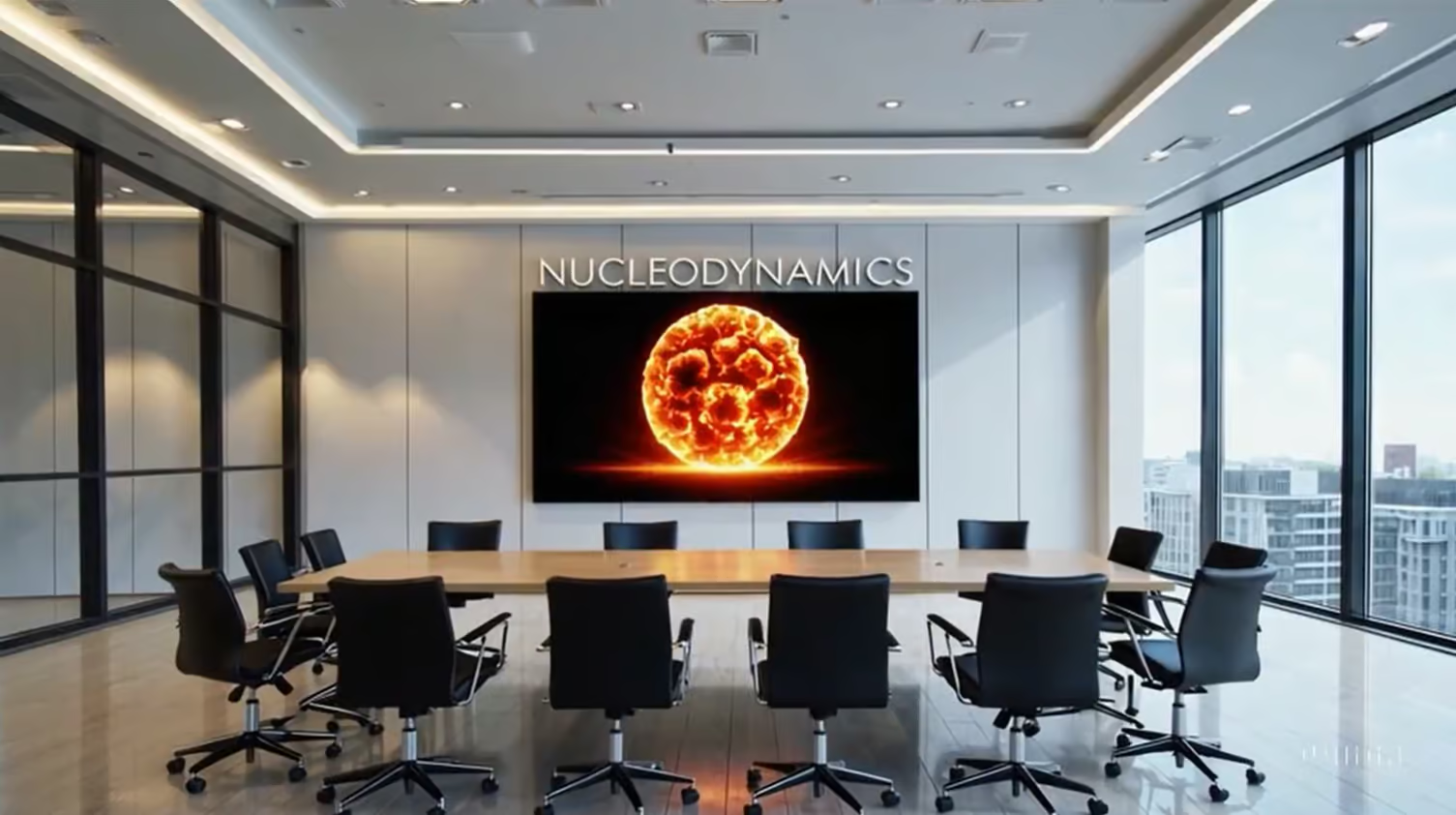
ISO 10012 — Mastering measurement to guarantee performance. The Solariom project must be integrated into a next-generation energy plant. The participant takes on the role of a technical expert from Nucleo Dynamics or Quantum Technologies, commissioned by Phoenix Corp. Their mission: establish a robust Measurement Management System before any industrial deployment. Identifying critical requirements, selecting appropriate measuring equipment, conducting risk analysis, ensuring metrological traceability — every decision has consequences for the rest of the scenario.
EN 9100 — Building a quality system for high-requirement environments. To meet the demands of a strategic client, Nucleo Dynamics must upgrade its ISO 9001 system to EN 9100 compliance. The participant plays the role of a consultant within Lyra or NovaSyn: analysing the existing system, identifying normative gaps, proposing structured improvement actions and driving the organisation’s maturity. Unexpected events challenge their decisions throughout the mission.
EN 9100 Auditor — Assessing system conformity and performance. Nucleo Dynamics’ management system is now operational. The participant takes on the responsibility of an EN 9100 auditor. They prepare the audit, conduct interviews, analyse documentary and field evidence, then formulate substantiated findings. At the end of the exercise, they rule on Nucleo Dynamics’ fitness to hold EN 9100 certification. The stakes are high: the participant must balance thoroughness with pragmatism, just as in a real third-party audit.
What immersive training actually changes
In each pathway, the participant does not consult the standard — they experience it. They interact with key stakeholders — quality managers, operators, senior management — structure their analysis and make informed decisions. This active pedagogical approach produces four measurable effects:
Learning by doing: the skills developed are operational, not merely theoretical. Participants have solved problems, weighed options and justified their choices.
Systemic understanding: rather than memorising isolated requirements, participants grasp the meaning and purpose of each normative clause within a broader industrial context.
Active cognitive engagement replaces passive memorisation. That is the condition for genuine transfer to the workplace.
Immediate transfer: learnings translate directly into the participant’s professional environment, because they were built under conditions close to reality. There is no gap between the training room and the shop floor — the training room is the shop floor.
Stronger engagement: scenario-based learning stimulates critical thinking and anchors knowledge durably. Participants no longer endure training — they live it. Feedback from participants consistently highlights that the immersive format creates a level of involvement that traditional classrooms simply cannot match.
Immersive training and the Q-SYNQ® approach: the same logic
This active pedagogy aligns with the philosophy of the Q-SYNQ® method developed by QALIA Performance: combining quality engineering with an understanding of human dynamics within organisations. Training an auditor or a quality manager is not just about teaching a standard. It also means teaching them to navigate organisational complexity — power games, resistance, territorial logic — which ultimately determines whether a management system succeeds or fails.
QALIA’s scenario-based programmes integrate this dimension. The scenarios are not simple technical exercises: they reproduce the tensions, trade-offs and constraints that professionals encounter in the field. It is this fidelity to reality that makes the difference.
Three industrial scenarios. Three strategic missions. One question remains: which immersive experience will you choose?